Got another mega post I’m really excited to share.
While helping a client with drip email sequences I stumbled across this awesome resource from an expert I really really love (🙏 Bryan from growthtools.com).
I’m including it here so you can do more of what works.
When you make the millions with one of these tactics, go show him some love to say thanks. Or maybe go do that right now.
– Daniel
Want me to find the best 2-3 ways to grow your business or personal brand? Book a free Strategy Call & we’ll design an action plan for taking advantage of them.
 Bryan Harris
30-Day Drip Email Sequence Challenge
In this post you will learn how to write an effective email sequence to welcome new subscribers and sell your products automatically.
In fact, over the next 4 weeks, you’re going to see behind the scenes of email sequences from 6 successful online companies. You will see everything from open rates, to click rates, to sales numbers, to the exact copy that’s used for their most successful email sequences.
For example…
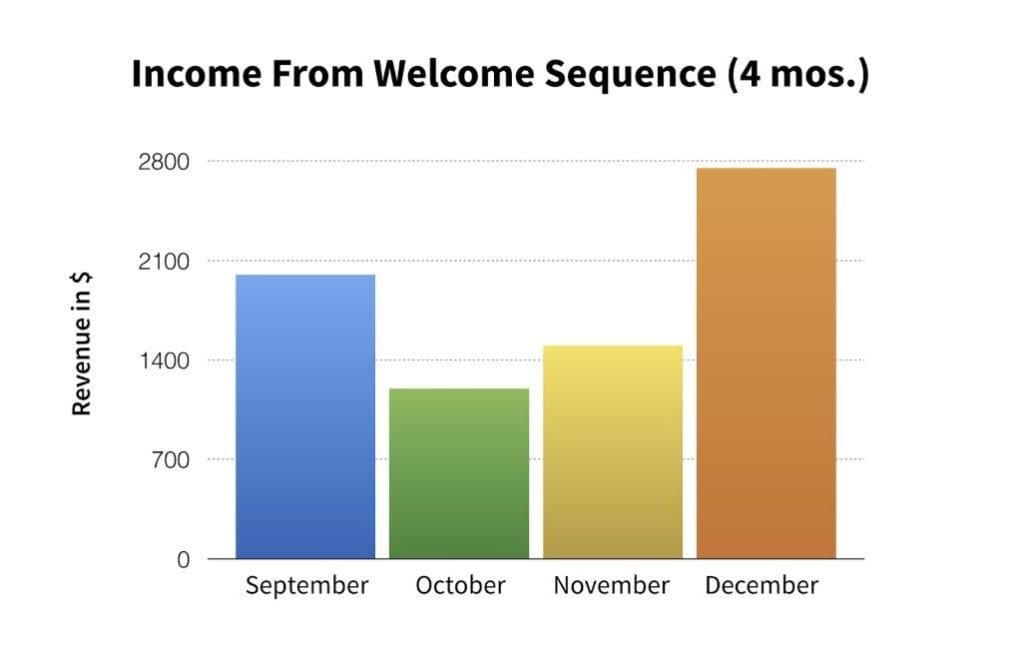
Laura Elizabeth, who runs Client Portal, a software service that helps freelancers manage their client work better. She makes $2,000 per month automatically from her email sequences.
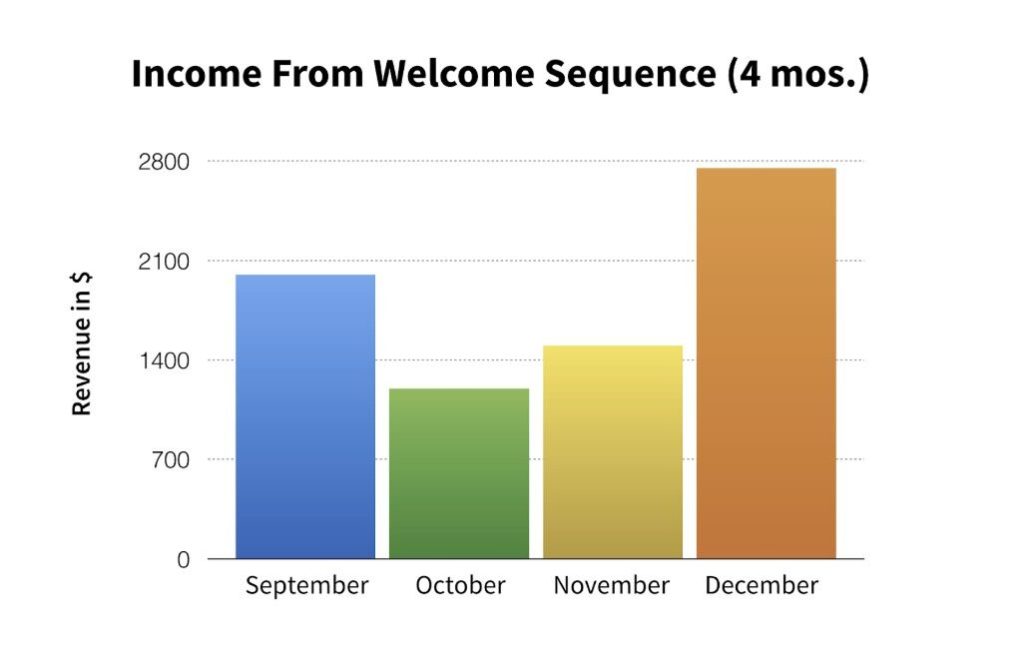
How does she do it?
Once a week, she sends 2 carefully crafted email sequences to the new people who have joined her email list:
Sequence #1: Welcome Sequence – This introduces them to her business and gets them ready for the next step she wants them to take.
Sequence #2: Sales Sequence – This presents a compelling offer and incentivizes them to purchase now.
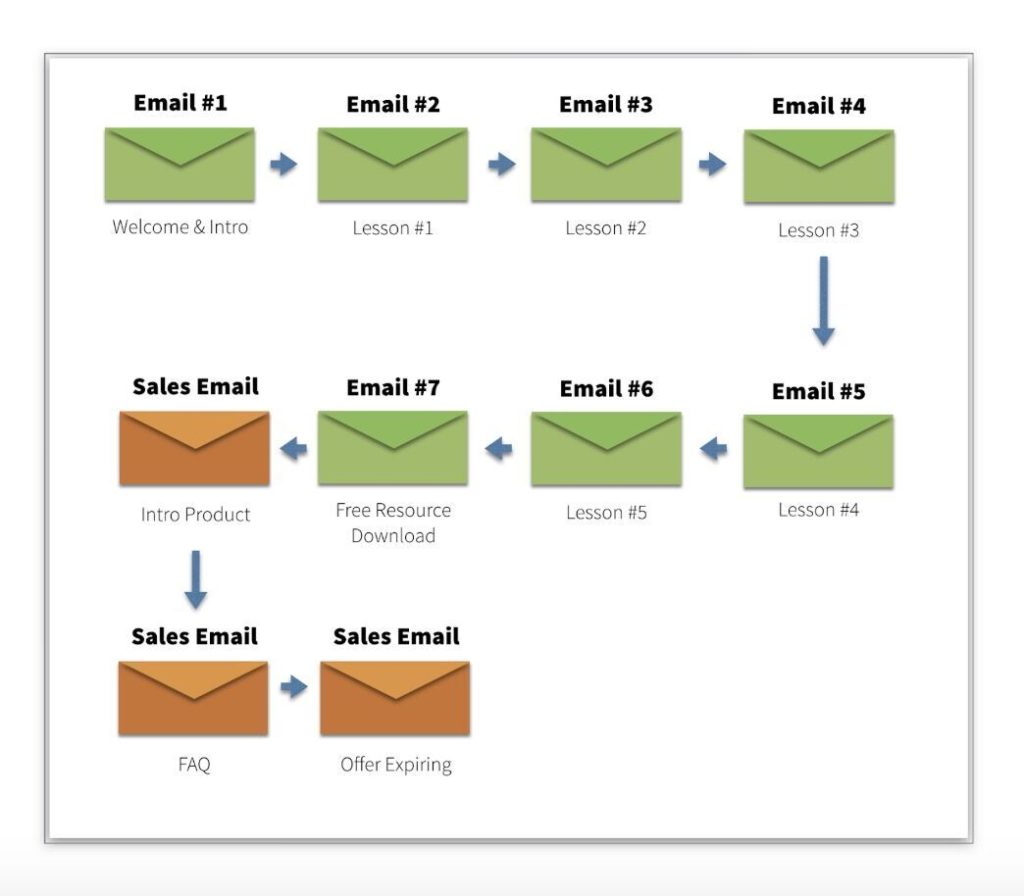
Here’s the high-level outline of her 2 sequences:
Welcome Sequence
Day 1: Welcome, Free Email Course Introduction
Day 2: Lesson 1
Day 3: Lesson 2
Day 4: Lesson 3
Day 5: Lesson 4
Day 6: Lesson 5
Day 7: Free Resource Download
Sales Sequence Begins
Day 8: Introduce Offer
Day 9: FAQ
Day 10: Offer Expiring
Every single business should use these 2 types of email sequences. But 99% don’t. Why?
Because writing your own email sequences from scratch is freaking hard.
1. How do you structure it?
2. Where should the offer go?
3. What should you even say?
It can feel impossible to get started when you’re not sure how a great email sequence is supposed to be structured or what content to include.
Over the next 4 weeks, we’re going to fix that!
By the end of this 4-week series, you’ll have the confidence, knowledge, and templates needed to write your own high-converting welcome sequence and sales sequence.
Here’s a quick overview of what we’re going to look at each week:
- Week 1: Behind the Scenes of 3 High-Converting Welcome Email Sequences
- Week 2: The Ultimate Welcome Sequence Template
- Week 3: Behind the Scenes of 3 High-Converting Sales Email Sequences
- Week 4: The Ultimate Sales Sequence Template
Ready? Let’s dive in!
Part 1: Behind the Scenes of 3 High-Converting Welcome Email Sequences
The Welcome Sequence is the one type of email sequence you literally can’t have an excuse for not writing.
You don’t need to have a product before you can write a welcome sequence.
You don’t need to have a single email subscriber before you can write a welcome sequence.
And with the resources you’ll get in this post, you won’t even need to be a great writer to write a welcome sequence.
But before you can write a great welcome sequence, it’s best to have an idea of what a great one looks like. That’s why I’ve sourced real sequences from 3 different businesses that are all performing well and included them for you below.
You’ll see everything from open rates, to click rates, to sales numbers, to the exact copy that’s used for each of these welcome sequences:
- Sequence #1: Laura Elizabeth, founder of Client Portal (software product)
- Sequence #2: Jeff Goins of GoinsWriter.com (course/info product creator and bestselling author)
- Sequence #3: Val Geisler of ValGeisler.com (freelance/consulting services)
I’ve also included my personal notes on each sequence, so you can see what stands out about each one and why I think you should study them.
Welcome Sequence #1: Laura Elizabeth, Client Portal
Business Type: Software
Teaching your new subscribers something valuable is one of the best ways to design a welcome sequence. Not only will you help them get to know your personality and brand, you’ll also build trust by helping them achieve a series of wins in the process.
That’s exactly what Laura Elizabeth does in the 10-part sequence she created for ClientPortal.com—it gives subscribers 5 lessons about automating their client process and then gives them an offer for her software product that makes the process even easier.
It may not seem like a welcome sequence in the traditional sense, but this is exactly the kind of sequence you should create if you don’t publish blog content. A free email class can be the perfect way to introduce yourself, welcome prospects to your brand, and ultimately turn them into customers.
Sequence Results:
- 11.5% of subscribers convert into customers
- $2,000 in sales a month (on average) and runs 100% on autopilot
Origin Point:
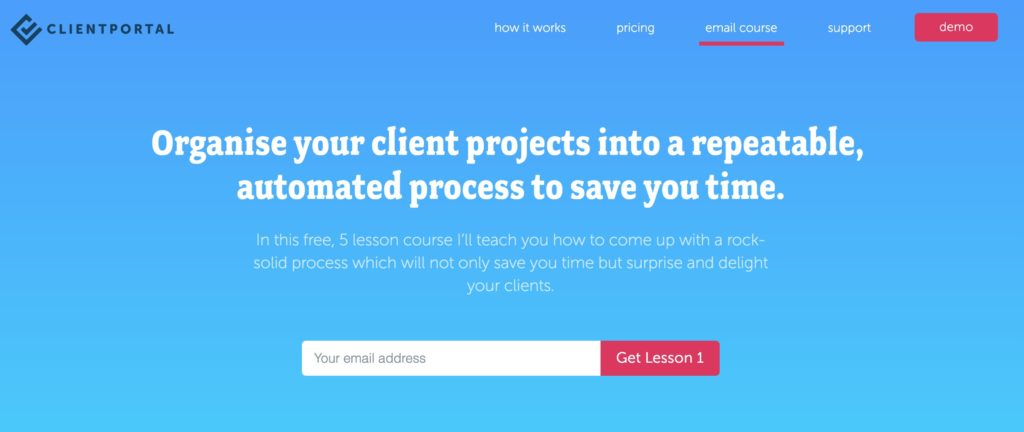
This is where people sign up to receive Laura’s email sequence:
After they sign up, they receive the following emails:
- Email 1: Introduction, Question – Gives subscribers a friendly hello and asks about their #1 pain point in order to increase replies and get customer insights
- Email 2: Lesson 1: Why automate? – Helps subscribers understand the benefits of the free course
- Email 3: Lesson 2: Onboarding clients – Teaches subscribers a solution to a common pain point
- Email 4: Lesson 3: Reduce client calls – Teaches subscribers a solution to a common pain point
- Email 5: Lesson 4: A memorable experience – Teaches subscribers a solution to a common pain point
- Email 6: Lesson 5: Closing a project – Teaches subscribers a solution to a common pain point
- Email 7: Free Resource Download – Gives subscribers a surprise bonus resource
- Email 8: Introduce Offer – Gives subscribers a limited time offer on Client Portal software
- Email 9: FAQ – Answers common questions and overcomes objections about the product
- Email 10: Offer Expiring – Gives subscribers a final reminder about the expiring offer and increases urgency
3 Cool Things to Watch for in This Sequence:
1. Adding One Question to Email #1 Makes It Valuable—Even If People Don’t End Up Buying
Check out how Laura ends her first email:
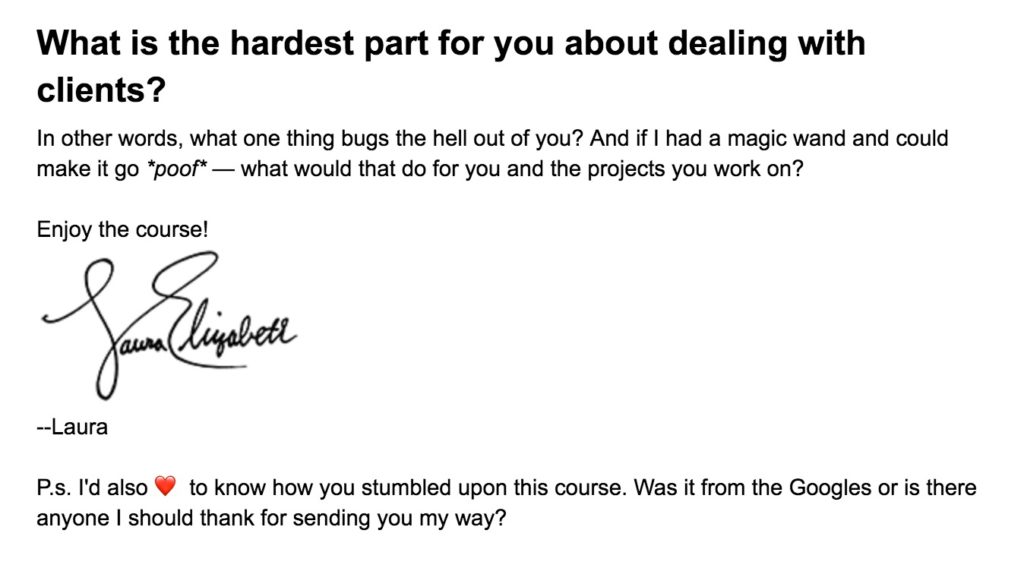
The responses she gets to that question are almost as valuable as actual sales of her product.
Why?
Because getting prospects to tell you about these kinds of pains is the #1 thing you need in order to:
- Build great products
- Write copy that will sell those products
- Create high-quality, helpful content for your subscribers
It’s also just a great way to build relationships and seem more human to your subscribers. Plus, email replies can increase your deliverability rate.
2. She Gives Subscribers High-Value Resources They Can Actually Implement.
If you’re teaching subscribers how to do something in your emails, you need to help them apply that knowledge. If you can help them have an “aha!” moment before they’ve even become a customer, they will be lining up to buy from you.
That’s why I love how actionable some of the resources Laura includes in her “Lesson” emails are. In Email #6, she gives a word-for-word email script her subscribers can send to clients in order to get high-quality testimonials:
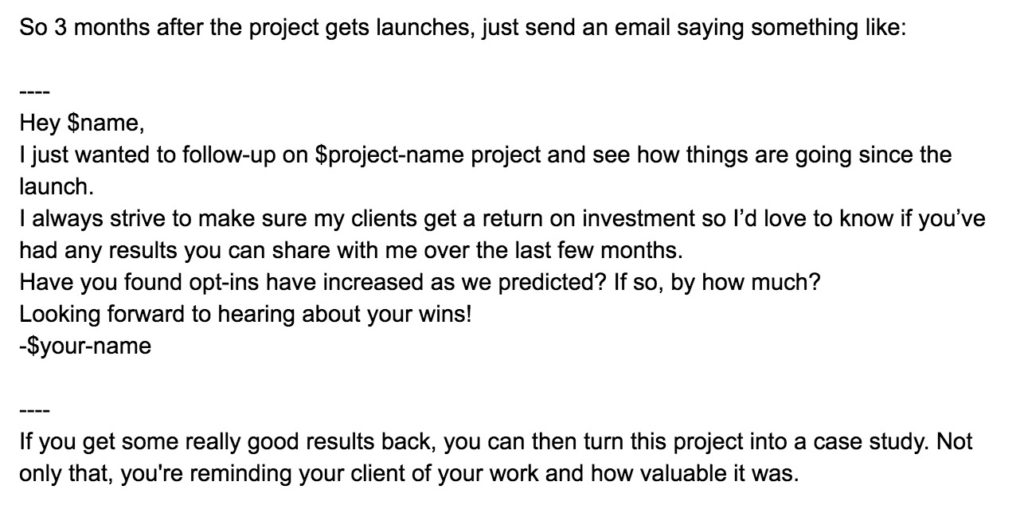
Giving away this level of value in your emails practically guarantees people will run to their inbox every time you send something new.
At the end of each lesson email, Laura gives subscribers a bite-sized, crunchy action item.
Helping your subscribers get quick wins is one of the best ways you can build trust. Do that early and often and converting them into customers will be a lot easier when the time comes.
3. She Ends Every Email with a Great Tease of What’s Coming Next.
Most email sequences feel like a bunch of random repurposed content that just got thrown together at the last minute. They feel disconnected, which makes it easy for subscribers to drop off and disengage.
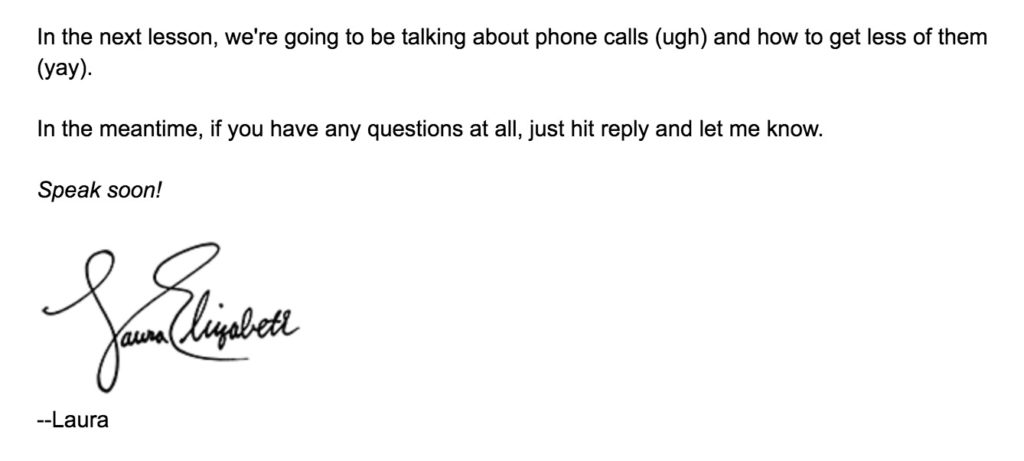
Since Laura understands her audience’s pain points super well (remember what I said about Email #1?), she’s able to perfectly tee up the next email at the end of each message.
Like this example at the end of Email #3:
And this example at the end of Email #5:
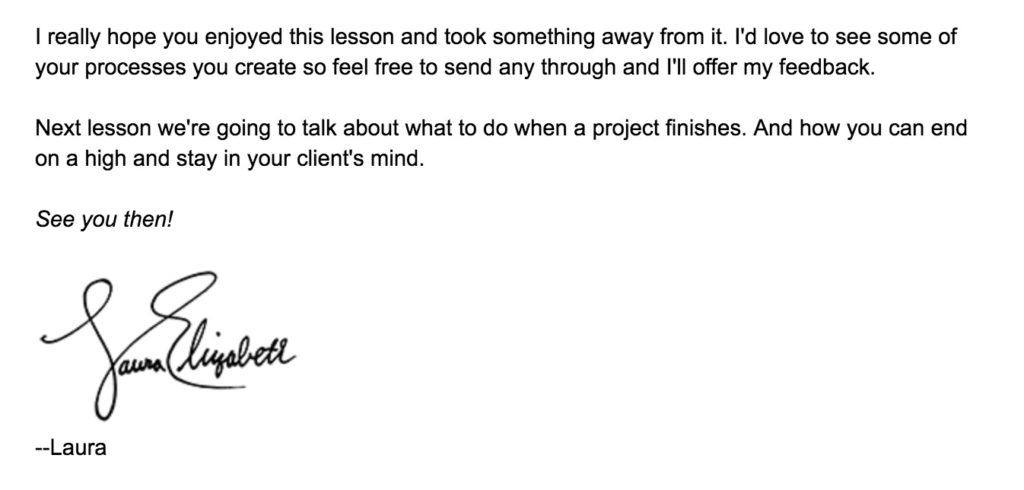
Notice how she’s also using the end of each email as an opportunity to get more replies so she can continue establishing relationships with her subscribers. It looks small, but it goes a long way!
Click Here to Get Laura’s Entire Welcome Sequence (Including Open and Click Rates for Every Email)
Welcome Sequence #2: Jeff Goins, GoinsWriter.com
Business Type: Course creator, blogger, author
Jeff Goins runs one of the most popular blogs in the world about writing. Hundreds of thousands of aspiring writers have joined his email list, and this is the sequence of emails they receive immediately after signing up.
As you’ll see, the goal of the sequence is to help them get to know Jeff, teach them a valuable lesson about becoming a writer, and then introduce them to some of his best introductory products.
If you sell courses or information products, you’ll definitely want to check this one out.
Sequence Results:
- Jeff’s welcome sequence drives an average of 250 registrations for his sales webinar every month. The emails have an average open rate of 28%.
Origin Point:
Jeff’s welcome sequence goes to people who sign up for his newsletter from his blog page:
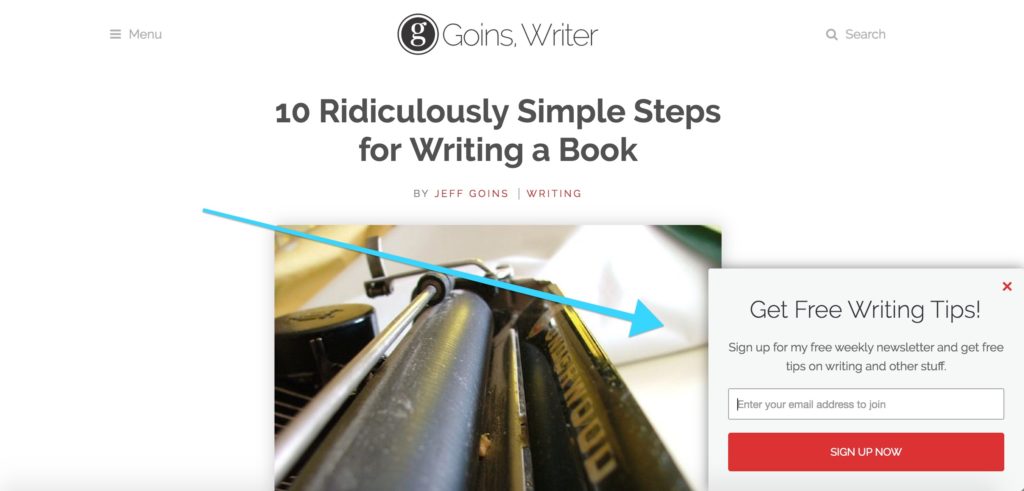
After they sign up, they receive the following emails:
- Email 1: Introduction – Establishes who Jeff is, builds credibility, and shows subscribers why they should keep reading
- Email 2: Paint the Dream – Encourages subscribers to follow their writing dream and gets them excited about what’s coming next
- Email 3: The Breakthrough/Webinar Invite – Helps subscribers overcome an emotional hurdle and gives them a free resource
- Email 4: Webinar Invite #2 – Drives webinar registrations
- Email 5: Webinar Reminder – Drives webinar registrations
- Email 6: “Coffee Invite” – Drives sales for a low-cost introductory product
3 Cool Things to Watch for in This Sequence:
1. Jeff’s Genius Double Opt-In Link
Asking people to confirm their email address = major buzzkill.
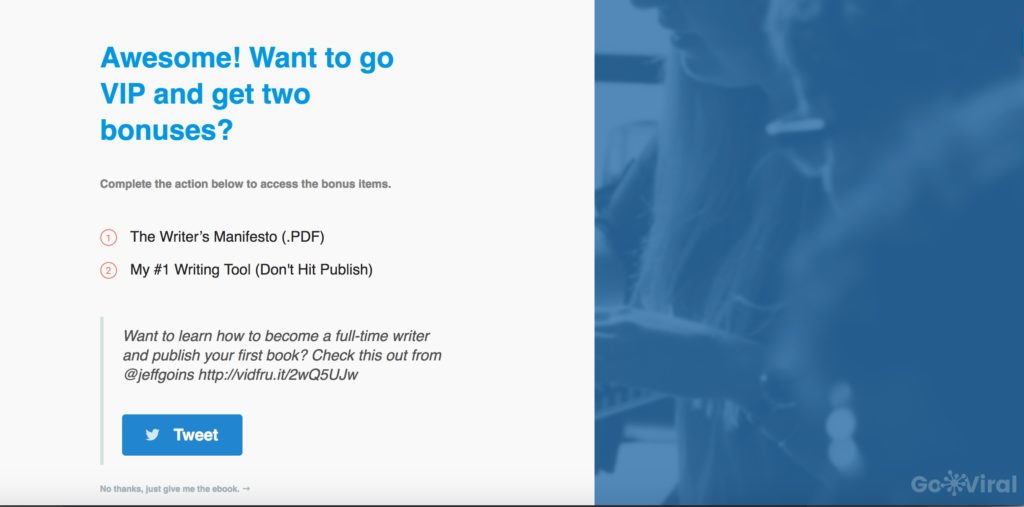
That’s why I love the way Jeff pulls it off in Email #1. He uses the double opt-in link to not only confirm your email address, but also to give you some sweet bonus resources:

When you click the confirmation link it redirects to a page where people can unlock bonus content by sharing his site on social media. (This page is made with our free growth tool, GoViral.)
2. Instead of Pitching a Product via Email, He Asks Subscribers to Register for a Free Webinar.
Sometimes, even after a great welcome sequence, you still might not feel totally comfortable with sending your newer subscribers a sales pitch.
Luckily, that’s not the only option you have. Jeff, for example, points his new subscribers to his weekly webinar after they’ve received the first three emails:
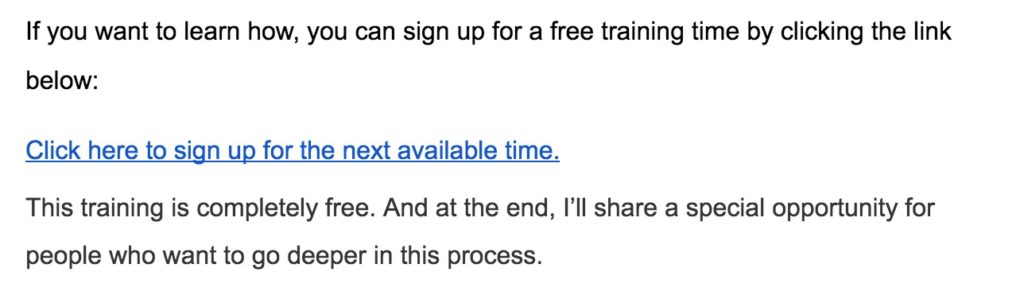
Not every welcome sequence has to end with a hard-sell via email. It just needs to point subscribers to the next step they can take to advance further down your funnel.
For some, that will mean a webinar. For others, it might be a free video series. Or a 1-on-1 consultation call.
Whatever that next step is, just make sure you give subscribers an opportunity to take it.
3. He Invites You to Get Coffee with Him.
Well, sort of. 🙂
The subject line of Jeff’s final email in the sequence is “Let’s grab coffee.” Check out how he opens it:
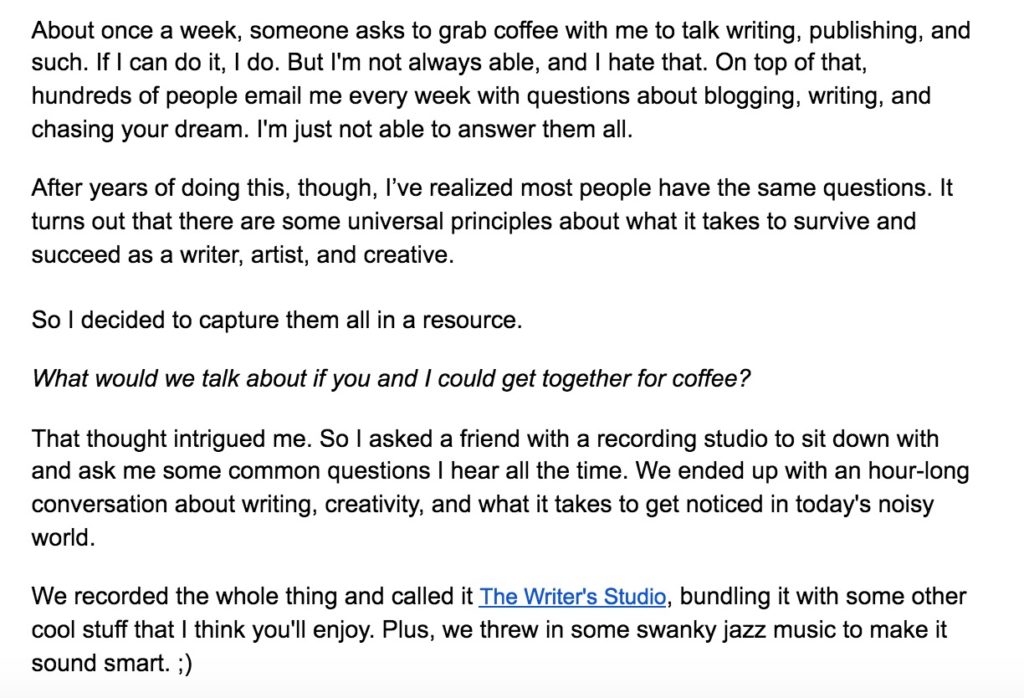
I love how this turns one of the most common requests people have for him into a compelling piece of genuinely helpful content.
It’s personal, playful, and compelling all at the same time. Plus, it’s a non-salesy way of introducing a low-cost product (it’s jut $17) to his subscribers, so Jeff can identify buyers early on for upsell opportunities.
Click Here to Get Jeff’s Entire Welcome Sequence
Welcome Sequence #3: Val Geisler, ValGeisler.com
Business Type: Freelance/Consulting Services
Val is a conversion copywriter and strategist for B2C startups.
Like most freelance/consulting service businesses, she works with more than one type of customer. Her welcome sequence helps her not only segment her list by customer type, but also provide each type with the kind of content that’s most likely to convince them to become a customer.
By the time they receive an offer for her services, they’re perfectly primed to say yes.
Sequence Results:
Val’s welcome sequence has led to $44,972 in sales.
Origin Point:
Val’s welcome sequence goes to people who opt in on her homepage:
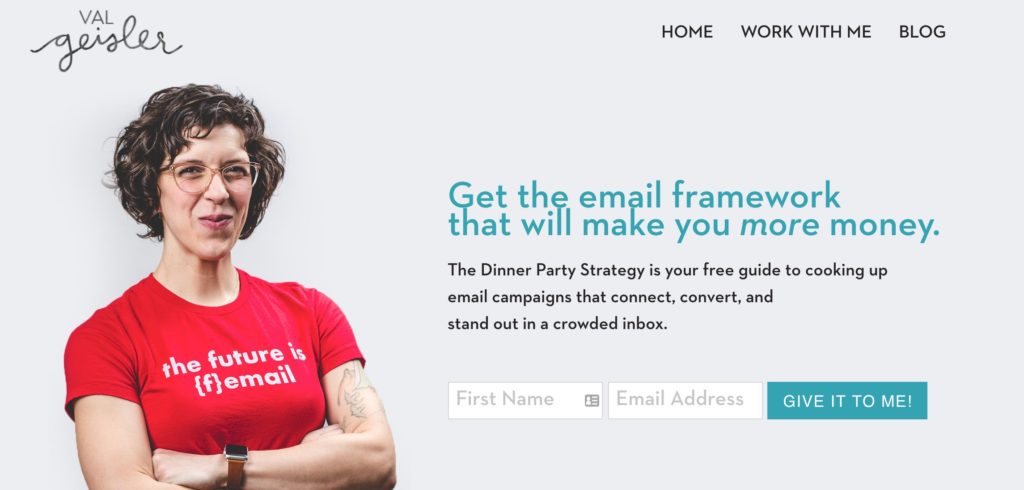
And to people who opt in at the bottom of her blog posts:
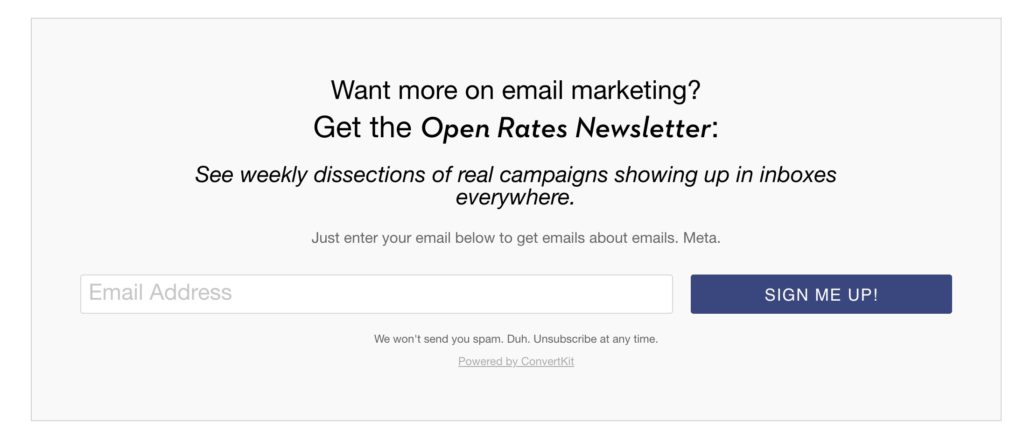
After they sign up, they receive the following emails:
- Email 1: Double opt-in confirmation/lead magnet delivery – Gives subscribers the lead magnet they signed up for (it only goes to people who sign up via the homepage)
- Email 2: Introduction/#1 Obstacle – Introduces Val to her subscribers in a fun way and gets them to reply with their #1 obstacle
- Email 3: Increase deliverability – Teaches subscribers a solution to a common pain point
- Email 4: How to build relationships – Teaches subscribers a solution to a common pain point
- Email 5: Choose your own adventure – Segments Val’s subscribers into her two types of buyers in a super fun/creative way
- Email 6: Segmentation reminder – Gives subscribers another chance to segment themselves (only goes to people who didn’t click Email 5)
3 Cool Things to Watch for in This Sequence:
1. Val Uses Personality and Humor to Break the Ice Instantly.
One of the worst parts about writing a welcome sequence is having to write about yourself.
Nobody likes it, but it’s kind of necessary if you want to actually stand out and have a relationship with your subscribers.
My #1 tip? Have some fun with it. The worst thing you can do is take yourself too seriously or be boring.
Val nails this part with her “5 Things You Didn’t Know About Me” section in Email #1:
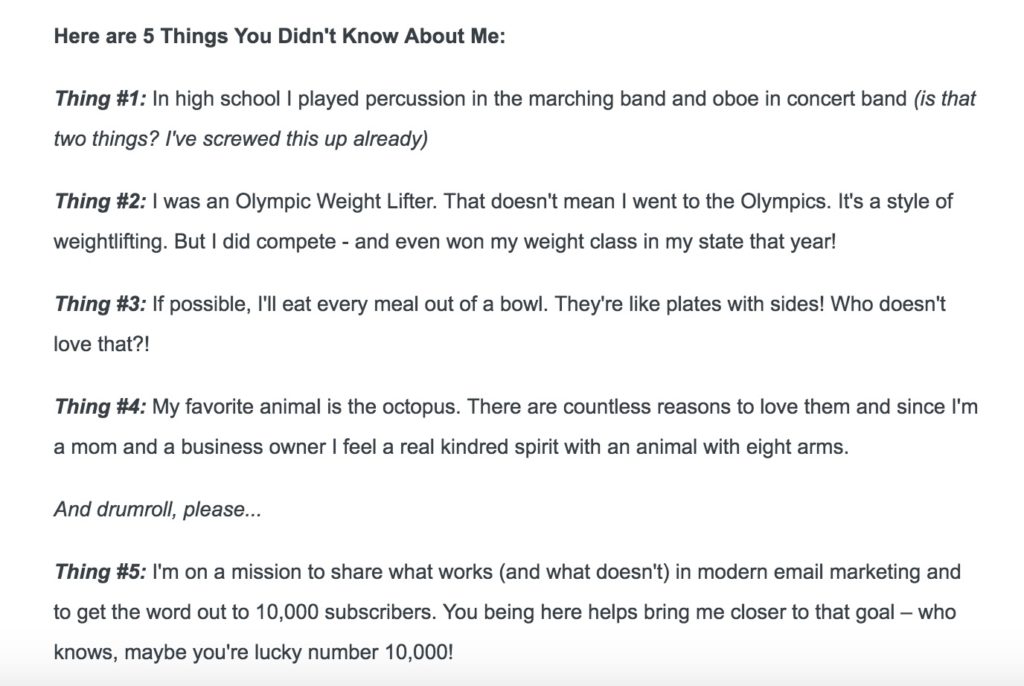
It’s fun and skimmable, and she ties it back into the reason you signed up in the first place with thing #5. This is the kind of stuff that will make people want to reply to your emails and get to know you better.
2. Her 2nd Email Is Super Actionable and Highly Valuable.
One of the easiest email mistakes to make is giving your subscribers too much to do.
It’s good to provide valuable content, but you don’t want to spend your first or second email trying to show them how to do something that’ll take hours.
Instead, start small. In Val’s second email, she gives subscribers a quick way to increase their email deliverability rate (after explaining how important and valuable deliverability rate is). Notice how she points out how fast they can do it:
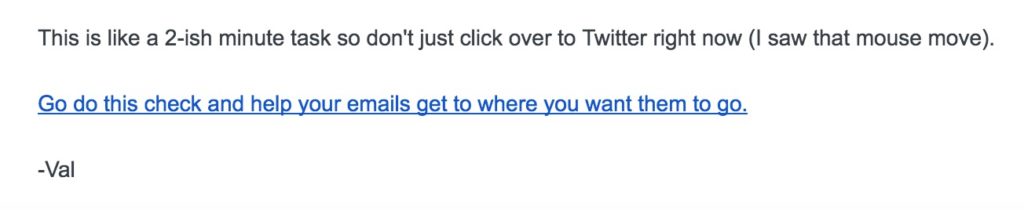
It’s a great reminder that small, quick wins are extremely valuable. Don’t lose sight of that.
3. The Smart Way She Segments Her List
Writing a welcome sequence can be pretty hard if you serve different types of customers in different ways. Sure, it’s easy to make the first few emails apply to everyone, but eventually you need to drill down and get specific with each type of customer.
So I really like the way Val gets her subscribers to segment themselves in Email #5. It allows her to split her two different customer types into separate sales sequences designed specifically for them:
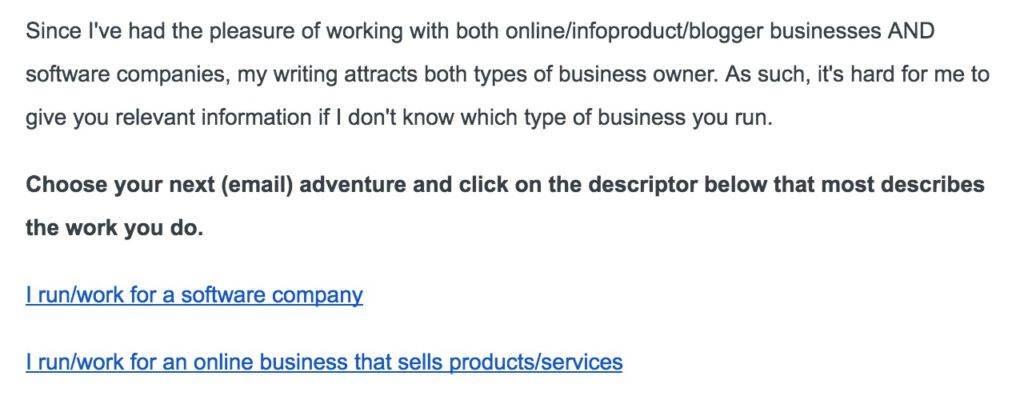
Considering the fact that this email gets a 27.7% click rate, I’d say it’s working pretty well.
(The real genius is in how she kicks off the email, so be sure to click through to the full sequence below.)
Click Here to Get Val’s Entire Welcome Sequence (Including Open and Click Rates for Every Email)
Part 2: The Ultimate Welcome Sequence Template
Last week, I showed you 3 high-converting welcome sequences from 3 different kinds of businesses. (They’re all available above this section if you missed them.) Each one was designed to engage new email subscribers and advance them to the next step in the business’s funnel.
Examples are good. But you know what can help you write your own sequence even faster? Templates.
That’s why we took the best elements from those 3 sequences, sprinkled in our 10 years of online marketing experience, and created an easy-to-follow, mad-lib-style template you can use to quickly write your own welcome sequence.
We think it’s as close as you can get to a fill-in-the-blank welcome sequence without ending up with emails that feel cookie cutter.
The whole thing is available in a Google doc below. It gives you a template for every email followed by a “filled-in” example version so you can see what each email template looks like with completed copy for an actual business.
Free Access: Get The Ultimate Welcome Sequence Template Now
A few quick tips to help you get the most out of the template:
- Don’t overthink it! Emails to your list should feel fresh and informal, just like the ones you send to friends and family. They don’t need to be perfect—they just need to add value and nudge the subscriber in the right direction. If you follow the template, your emails will do exactly that.
- Whenever possible, reuse existing content. This template is designed so you don’t have to create a bunch of new content from scratch, but there are a couple of sections where you’ll need to insert some how-to/teaching-style content. Don’t hesitate to repurpose existing content you already took the time to create.
- If you need to create a lead magnet to give new subscribers at the beginning of your welcome sequence, check out our free tool Attract. You can create a great-looking lead magnet in literally a few minutes with it. No more excuses! 😉
Part 3: Behind the Scenes of 3 High-Converting Sales Email Sequences
If you’re building an email list, your end goal likely involves eventually selling something to the subscribers on that list.
Bold prediction, right? 🙂
Here’s the problem: When the time comes to actually sell that something to your list, you’re likely to run into one of two problems…
- You’re so paralyzed at the thought of asking your subscribers to buy something that you’re not sure what to write.
- You send sales emails that don’t end up producing the results you were hoping for.
Both of these are totally understandable outcomes. Sales emails are intimidating and hard to get right if you don’t have much experience writing them. Especially when you’re writing about your own product.
You don’t want to say the wrong thing. You don’t want to come off salesy. You don’t want to abuse the relationship you’ve worked so hard to build.
But you know what makes the writing come easier?
Studying examples of high-performing sales sequences. (Big surprise, right?)
That’s why I’ve sourced real sales sequences from 3 different businesses that are all performing well and included them for you below.
You’ll see everything from open rates, to click rates, to sales numbers, to the exact copy that’s used for each of these sales sequences:
- Sequence #1: Amy Hoy and Alex Hillman’s launch sequence for their online course, 30×500
- Sequence #2: The Full Focus Store’s promo sequence for the Full Focus Planner (a physical planner created by Michael Hyatt)
- Sequence #3: Brady Shearer’s launch sequence for a done-for-you social media service from Pro Church Tools
I’ve also included my personal notes on each sequence, so you can see what stands out about each one and why I think you should study them.
Sales Sequence #1: Amy Hoy and Alex Hillman, 30×500
Business Type: Online Course
Amy Hoy and Alex Hillman are the creators of the 30×500 online course, which teaches aspiring entrepreneurs how to create successful products and build a business around them.
(They’ve also created a bunch of super successful products in addition to the course.)
But the key thing to know is that they write some of the best sales emails in the biz, which is why I was pumped when Alex offered to share all the details behind the sales sequence they use when they open enrollment for 30×500.
Enrollment is only open for a few windows each year, so this is an awesome example of an open/closed cart sales sequence. However, even if your product is available for purchase 24/7, I think you’ll still be able to take away a lot of great ideas from this sequence.
Sequence Results:
- $172,971 in sales the first time they ran the sequence (it’s gone on to generate more as an evergreen sequence since then)
- 80% of customers paid in full; 20% chose a payment plan
Origin Point:
This sequence is sent to their entire email list. Anyone who signs up via their blog at StackingTheBricks.com or the 30×500.com site will receive it during an open enrollment period for the 30×500 course.
The sequence contains the following emails:
- Email 1: Early Registration Special – Gives a segment of warm subscribers a limited time opportunity to enroll in the course at a discounted rate
- Email 2: Early Registration Closing – Lets the same segment of warm subscribers know the Early Registration discount is expiring
- Email 3: Pre-Launch Lesson 1 – 7 Hard-Ass Rules for Business and Life – Focuses subscribers on pursuing what matters most to them (steering them toward building a product/business)
- Email 4: Pre-Launch Lesson 2 – The Fundamental Problem with Employment – Gets subscribers to focus on the key problem that the 30×500 course is the solution to
- Email 5: Pre-Launch Lesson 3 – 5 Big Nasty Fears Keeping You on the Hamster Wheel – Agitates the key problem holding most of their subscribers back from their dream (also begins to tease the course launch)
- Email 6: Pre-Launch Lesson 4 – Be Your Own Angel – Presents the solution to the problem the previous emails described (and continues to tease the course launch)
- Email 7: Course Overview – 4 Things to Know Before You Join 30×500 – Gives subscribers the straightforward details about the course before it launches so they understand what it is and who it’s for
- Email 8: Cart Open – Announces enrollment for the course is open for a limited time
- Email 9: The 30×500 Philosophy – A teaching-style email that explains the fundamental approach the course teaches in an entertaining way
- Email 10: Case Study 1 – Tells a student success story and shows how 30×500 is different from typical courses
- Email 11: Case Study 2 – Presents another student success story and reminds subscribers about the limited enrollment window
- Email 12: What Happens After You Join – Shows subscribers step by step exactly what will happen after they enroll in the course, and presents additional case studies
- Email 13: Case Study Dump / Cart Close Reminder 1 – A trove of testimonials that speak to why 30×500 works, plus a reminder that enrollment closes at the end of the day
- Email 14: Cart Close Reminder 2 / Taste Test – Another reminder enrollment is closing + a recap of everything that’s included + a sample of course content
- Email 15: Cart Close Reminder 3 – One final reminder that enrollment is closing
3 Cool Things to Watch for in This Sequence:
- They use testimonials and case studies in an incredible way.
If you don’t have many testimonials or case studies for your business or products yet, don’t let that discourage you from studying how Amy and Alex deploy them throughout this sequence. Because they are absolute masters at it.
And if you learn the right way to use testimonials now, using them will be easy once you get some good ones. 🙂
For example, check out this excerpt from the beginning of a mini case study they use in their 10th email:
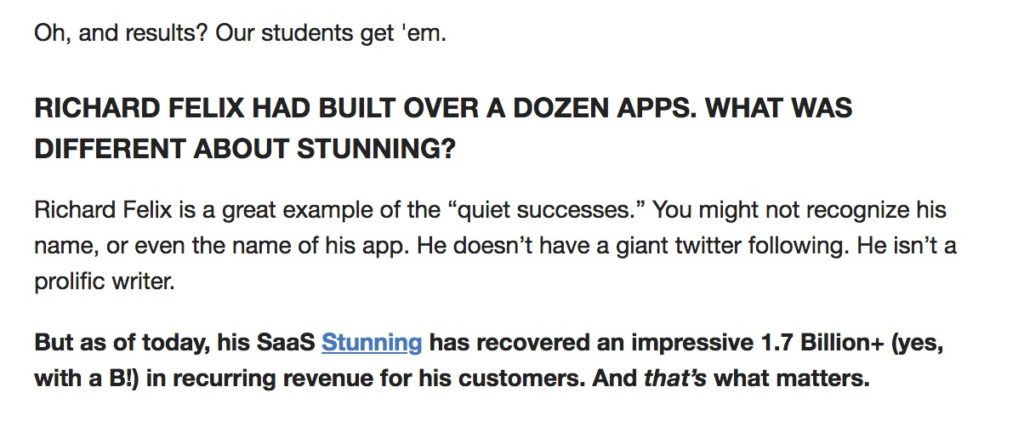
I want to turn this into a poster and put it on my wall to remind myself how to deploy a case study.
Notice how they don’t just say “Student X used our product and made X amount of money because of it.”
A line like that is fine, but it limits the value you can get from an example of customer success. Amy and Alex go much deeper. They use the case study to not only showcase student success, but to speak to their customers’ fears, pain points, and objections.
Take the headline, for example: “Richard Felix Had Built Over a Dozen Apps. What Was Different About Stunning?”
Past failures are one of the biggest things that hold their prospects back. Many of them have tried building products with little success in the past—so why should they believe they might be capable of building a successful one?
This headline tackles that objection head on. And the paragraph after it then tackles the “but no one knows who I am” objection.
Again, this is just one small example. They do this tons of times throughout the sequence in lots of creative ways. Keep an eye out and take notes for your own future case studies and testimonials.
- Their 2 “Early Registration” emails generated ~17.5% of total sales.
Amy and Alex did something pretty dang smart before kicking off this sales sequence to their entire email list:
They sent 2 emails with an “early registration” discount to a segment of people who were on a waiting list for their course. Those 2 emails alone brought in nearly 1/5 of their total sales… all before the launch had even officially started.
(If you’ve ever been through a launch, you know getting that kind of early momentum is a nice confidence boost.)
The really nice part is they didn’t even have to offer that big of a discount. They knocked just 5%, or $100, off the course’s regular $1999 price tag.
While you may not have a waiting list for your next launch, you do likely have certain subscribers on your list who are warmer leads than others. For example:
- People who have already purchased other products or services from you
- People who frequently open your emails
- People who frequently click your emails
It’s worth considering ideas for special offers you can give to your warmest leads if you want to build some early sales momentum into your sequence. Check out those two emails from Amy and Alex to see how they do it. (You’ll find them in the spreadsheet we link to below.)
- The final day saw a massive spike in engagement.
They sent 3 emails on the final day of the 30×500 launch. Notice the difference in those emails’ open and click rates vs. the rest of the sequence:
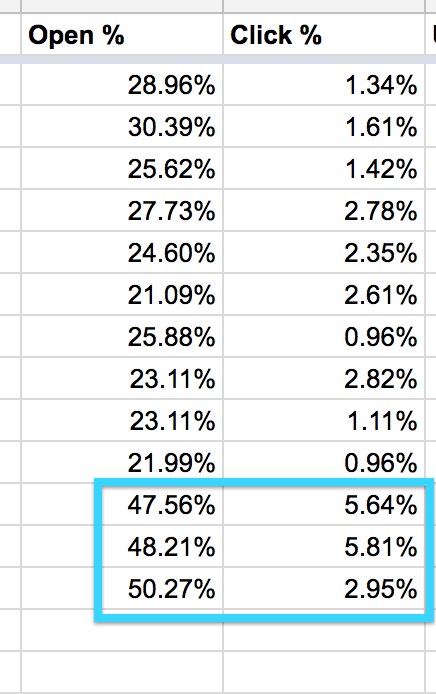
WOW.
Listen, I get it. Blasting your list with 3 emails in one day can feel a little scary. You don’t want to annoy anyone. You don’t want to seem spammy.
But when you have an expiring offer, the final day is magical for engagement and sales. When you capitalize on it, the positive impact for your business far outweighs the tiny negative impact of the couple handfuls of people who might get a little annoyed or unsubscribe from your list.
The best part? Most of those final day emails don’t even need to be long or complicated. In fact, the final email in the 30×500 sequence is two sentences long! I fit the whole thing in this tiny screenshot:
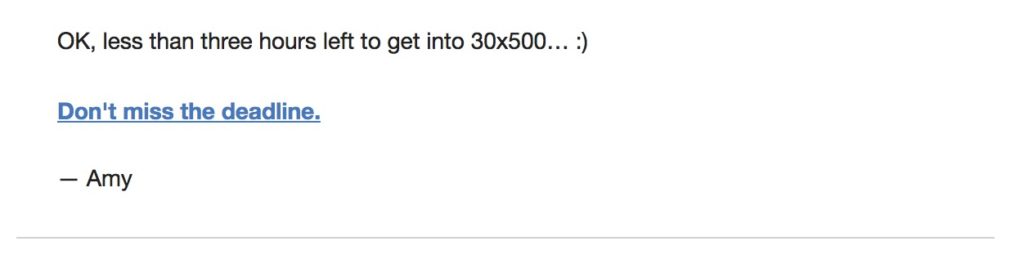
If you’ve put effort into the other parts of your launch (product, sales page, early sequence emails, etc.) the final day is mostly about reminding your list it’s their last chance. Don’t let that opportunity pass you by.
Click Here to Get the Entire 30×500 Sales Sequence (Including Open and Click Rates for Every Email)
Sales Sequence #2: Full Focus Store (Michael Hyatt), Full Focus Planner
Business Type: Ecommerce
You might already know Michael Hyatt from his massively popular blog and bestselling books, but he’s also been running his own ecommerce brand called the Full Focus Store for the past few years. They have a product line of planners, journals, and notebooks that can be purchased individually or as an annual subscription.
In August of 2018, the store launched an updated version of their first product, the Full Focus Planner. To promote the launch to their email list of over 300,000 people, Michael’s team created an 8-email sequence offering a limited-time discount on the new planner.
Part of the reason we chose to highlight this sequence is because it’s dramatically different from the other examples in this post. While the others are pretty much entirely text-based, this Full Focus Store sequence relies heavily on visuals, which is something you see pretty often in ecommerce emails. If you sell physical products, you’ll definitely want to check it out.
Sequence Results:
This sequence resulted in a 34% increase in sales from a similar limited-time promotion they ran several months earlier. Granted, some of that increase should probably be credited to the fact that they were promoting an updated version of the planner, but it’s still a great example of a well-executed ecommerce sales sequence.
Origin Point:
The sequence went to anyone who signed up for Michael Hyatt’s email list on MichaelHyatt.com or purchased a product previously from the Full Focus Store.
They received the following emails:
- Email 1: Coming Soon – Teases the launch of the new planner
- Email 2: Now Available – Announces the new planner is available and offers a limited-time discount
- Email 3: 5 Things You’ll Love – Explains the benefits of the updates they made to the planner
- Email 4: The Planner Lifestyle – Showcases the planner in a variety of appealing contexts
- Email 5: Social Proof – Provides ratings, testimonials, and reviews of the planner
- Email 6: Note from Michael – A plain-text-style email from Michael Hyatt that goes into more detail about the updates made to the planner
- Email 7: Sale Ending Reminder #1 – Lets people know the sale is ending soon and reminds them of the planner’s main benefits
- Email 8: Sale Ending Reminder #2 – A final reminder that the launch discount is about to expire
3 Cool Things to Watch for in This Sequence:
- They let the photos do the talking.
Great copy will never stop being important when you’re trying to create a great email sequence.
But sometimes it pays to shut up and let people just see your product. Especially when it’s as pretty as this:
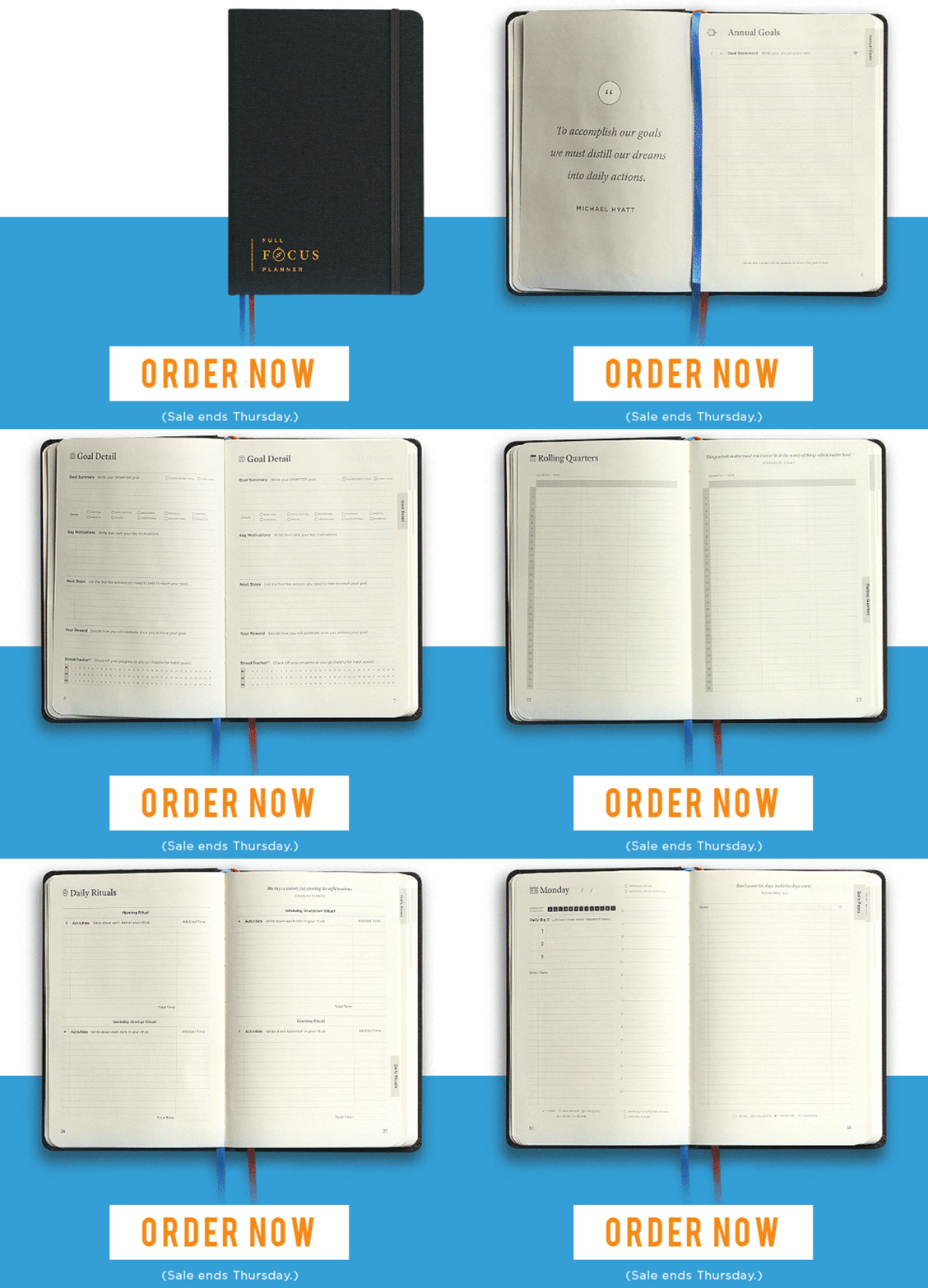
Since their audience had seen several promotions for the planner in the past, simply letting them know that
- it’s been completely redesigned and updated
- it’s on sale for a limited time
- it’s pretty sexy…
… was an effective way to get people to click through to the sales page (which was full of great copy).
Since the majority of emails Michael sends his list are text-based, these image-heavy emails were also probably a nice pattern interruption.
- They sent a CTA-less “Coming Soon” email.
I love the simplicity of the first email they sent to tease the sale.
It’s like the email equivalent of one of those teaser images you see Netflix tweet out when they start promoting one of their shows’ new seasons:
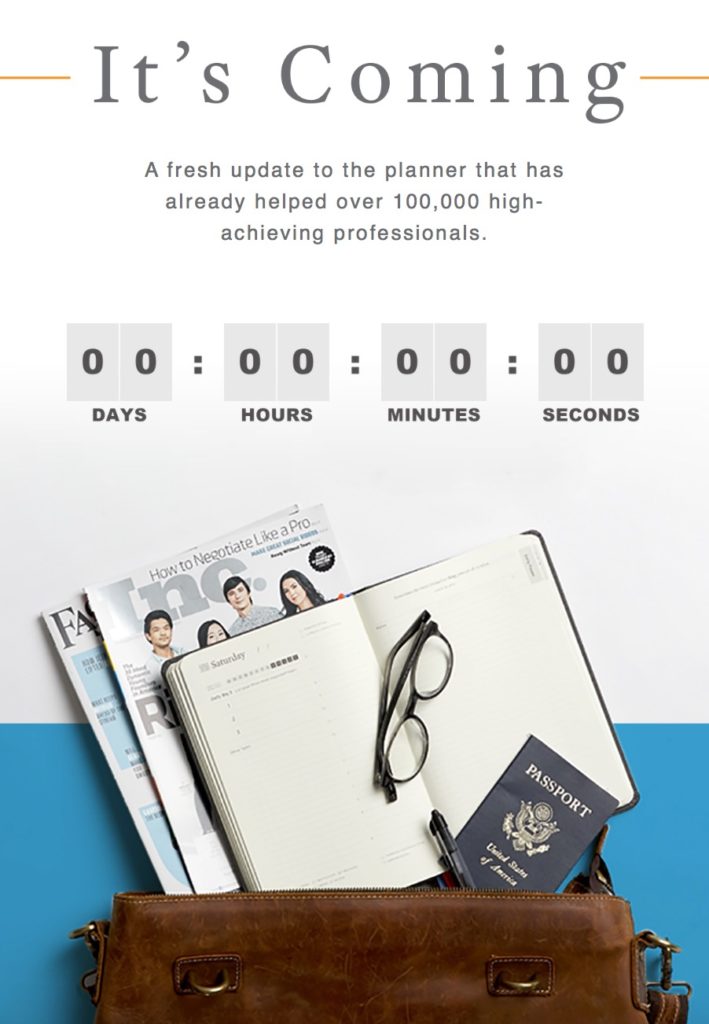
That’s it! There’s not even a link you can click on. Just enough information to make you want to keep an eye on your inbox tomorrow.
Also, bonus points for showing a passport next to the planner and making me feel like I could be a Jet-Setting Cool Guy too if I just started using it. 😉
- They still sprinkled in a plain-text email for some variety.
Email 6 is a plain text email from Michael, which sticks out like a sore thumb when you’re looking through the sequence.
And I mean that in a good way!
When you’re sending emails to the same people day after day, it’s good to vary things. Speak to different customer types. Appeal to different benefits or pain points. Let people learn about your product in different formats.
No single email is going to get the attention of your entire audience. So try connecting with them in different ways.
Sales Sequence #3: Brady Shearer, ProChurchTools.com
Business Type: Done-For-You Services; Software
Brady is the CEO of Pro Church Tools, which sells a variety of tools and services to help churches reach more people.
(Pro Church Tools also has one of the most well-designed websites I’ve ever seen, so be sure to check them out.)
This sales sequence was used to launch Brady’s done-for-you social media service for churches. One of the reasons I love it is because it follows the open/close cart launch style that you probably associate with online course launches, but in this case it’s selling a done-for-you service rather than a digital info product.
It’s a good reminder that you don’t have to launch or promote your product the same way every other kind of business like yours does. You can get great results borrowing strategies that have worked well for other types of products and applying them to your own.
Sequence Results:
While I can’t share exact launch numbers for Brady’s launch, just trust me when I tell you that I’ve seen them and they’re prrrrrettty dang good. 🙂
And the good news is you’ll still get to see open and click rates for all the emails when you check out the full sequence at the end of this section.
Origin Point:
This sequence went to everyone who signed up for the Pro Church Tools email list.
Here’s the basic structure:
- Email 1: Pre-launch content #1 – Gives subscribers a free checklist lead magnet + video training that’s designed to help them with social media to prime them for the upcoming done-for-you social media service launch
- Email 2: Pre-launch content #2 – Gives subscribers a collection of social media post templates + video training to continue priming them for the launch (sent again with a different subject line to subscribers who didn’t open it the first time)
- Email 3: Pre-launch content #3 – Gives subscribers a social media calendar + video training to continue priming them for the launch (sent again with a different subject line to subscribers who didn’t open it the first time)
- Email 4: The launch preview – Teases the upcoming product launch
- Email 5: Cart open – Officially announces the launch (plus a fast action bonus) and sends subscribers to the sales page
- Email 6: Flash bonus – Offers a that’s only available for the next 24 hours
- Email 7: Problem, agitate, solve – Touches on one of the audience’s biggest pain points and positions the product as the solution using the PAS formula
- Email 8: Customer reviews – Showcases positive results from customers who have used Brady’s service in the past
- Email 9: FAQ – Reminds subscribers the cart will be closing in one day and links them to an FAQ page to overcome their most common objections
- Email 10: Cart close reminder #1 – Reminds subscribers that it’s the final day of the launch
- Email 11: Cart close reminder #2 – Gives subscribers one final warning that the cart is closing and includes some additional customer results / social proof
3 Cool Things to Watch for in This Sequence:
- A social proof email SHOWS what great results look like instead of just telling you about them.
We’ve all seen sales emails that feature testimonials or customer success stories. And there’s a reason for that… they work really well! People like to see proof that a product can produce the kinds of results they’re going for.
But what I love about Brady’s email is that after describing some of the increases in comments, views, and overall engagement their service has achieved for customers, he does this:
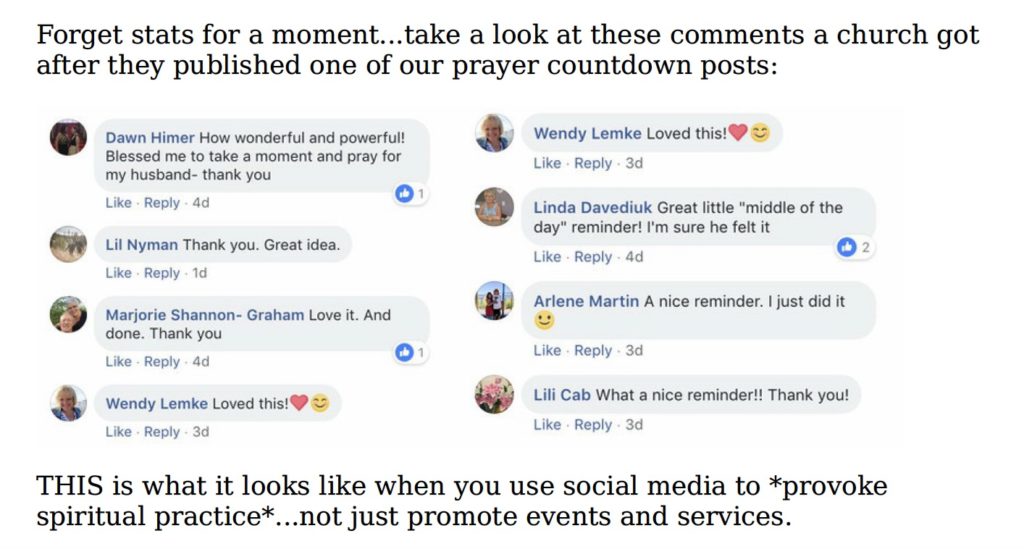
This is like the equivalent of one of those “before/after” photos you see in an exercise equipment or diet program commercial. It allows prospects to SEE what those great results look like, which makes it a lot easier to imagine how it would feel to achieve them.
Powerful stuff.
- He lets the voice of the customer come through.
You probably know by now that it’s a good idea to talk about the problems your product solves in your sales sequence. Reminding people about a pain point they have to constantly deal with is a surefire way to grab their attention.
But what’s the best way to bring up those pain points? One of my favorites is to simply use the exact words your customers use to describe them. That’s why I like the way Brady does the seventh email in the sequence:
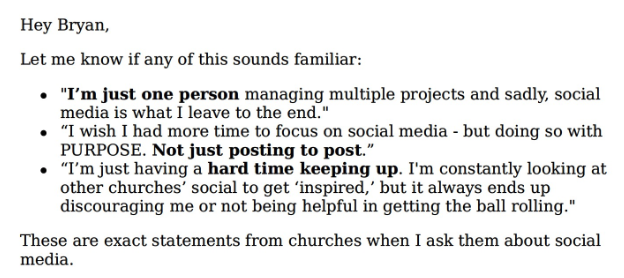
This is why talking to your customers (or prospects if you don’t have any customers yet) is so important. It not only helps you create better products, but it also helps you know what to address in your copy.
It also allows you to just copy/paste their words directly instead of having to write from scratch. Which is always nice. 🙂
- His pre-launch content perfectly aligns with his product.
Before sending his first sales email, Brady gave his subscribers the following free resources: a social media checklist for churches (PDF), 5 social media post templates, and a 7-day social media calendar (PDF).
Notice anything in common?
I’m not just talking about the fact that they’re all about social media. Obviously they have that in common. But the thing that really stands out to me is that they’re all actual tools that would be extremely useful to the types of people his product is designed for.
This is the kind of high-value pre-launch content that will get ideal customers to drop what they’re doing and RUN to open your emails every day. Which is exactly what you want them to be doing once you start sending emails about your product.
(By the way, if you want to create awesome, fancy-looking PDF lead magnets like the ones Brady used in his launch, check out our free tool, Attract. It lets you use proven templates to create beautiful lead magnets in minutes so you don’t have to worry about hiring a graphic designer.)
Click Here to Get Brady’s Entire Sales Sequence (Including Open and Click Rates for Every Email)
Part 4: The Ultimate Sales Sequence Template
Last week, I showed you 3 high-converting sales email sequences from 3 different kinds of businesses. (They’re all available above this section if you missed them.)
These kinds of examples are great for sparking ideas for improving your own sales sequences, but like I mentioned earlier in this post, actually writing your own sequence can still be pretty difficult. Even if you’ve got great ideas, putting them all together is usually a time-intensive process.
So this week we’re simplifying things even further for you. Just like we did with the welcome sequences at the beginning of this post, we took the best elements from the 3 sales sequences featured last week and created a fill-in-the-blank style template you can use to create your own sequence.
Whether you need to launch a product for the first time or run a limited-time promotion, you can use this sequence template to give yourself a proven structure and a running start.
It gives you a template for every email followed by a “filled-in” version so you can see what each email template looks like with completed copy for an actual business.
Free Access: Get the Ultimate Sales Sequence Template Now
A few quick tips to help you get the most out of the template:
- Use it for the “Open Cart” period of your launch or promo. Ideally, your subscribers will have received some type of pre-launch content designed to prime them for your sales sequence. When they receive Email 1 in the sequence, it shouldn’t be the first time they’ve ever heard of your product. If you need some ideas for pre-launch content, refer back to the 30×500 and Pro Church Tools sales sequences in the previous section.
- If you don’t have customer success stories or testimonials yet, don’t worry! If you’re launching a product for the first time, you probably don’t have a bunch of examples of great results people have achieved with it yet. But that doesn’t mean you don’t have any success stories that will give prospects more confidence in your product.Have you personally experienced great results with the product or with strategies the product teaches? Awesome! Use yourself as the success story. Is the product based on ideas/concepts/strategies that have helped people achieve great results? Showcase those stories!
- Feel free to adjust the timing elements of the sequence as needed (with one exception). The sequence is designed for a 5-day open-cart period, but don’t feel like you need to force yourself into that exact time structure. If a shorter or longer period would work better for you, it’s fine to adjust the timing of the emails to make it work.
My only caveat is to make sure you send at least two emails on the day you close the cart. Urgency is a powerful motivator, and there’s no day with greater built-in urgency than the final day of a launch or promo.
Here’s the link to the Ultimate Sales Sequence Template one more time.
Want us to find the best 2-3 growth opportunities for your business?
Book a free Strategy Call with our team. We’ll look under the hood of your business, identify your best growth opportunities, and show you the action plan for taking advantage of them.